We have been college volleyball fans for over 20 years and have attended the NCAA Division 1 Volleyball Final Four since 2003 when the Florida Gators battled for the title in Dallas. Being in Colorado for the start of the college volleyball season, it only seemed natural for us to find some matches to watch.
First stop on our weekend tour was the Air Force Academy in nearby Colorado Springs. This words on this mural (Integrity First, Service Before Self, Excellence In All We Do) on the wall of the cadet gym clearly shows the difference between athletics at a service academy and other colleges and universities.
In the first match of the evening, we got to see Arizona State (currently ranked in the top 10) from the PAC 12 soundly defeat Boston's Northeastern University. The PAC 12 is one of the stronger conferences in women's volleyball.
The next match was between Air Force and New Mexico State. A large crowd was on hand to cheer on the Falcons. In the photo below, the student section was on their feet as the Air Force team ran onto the floor.
During player introductions, "The Bird" led the crowd in cheers. Unfortunately, Air Force lost a hard fought match to New Mexico State.
The following day we headed north to Boulder, home of the University of Colorado, another PAC 12 school. Paul stood outside The Coors Event Center with a statue of the Colorado namesake--a buffalo.
Florida State easily defeated San Diego in the first match of the evening. In the second match, the University of Oklahoma squeaked by the host Buffs in a 5 set thriller. Chip, the Colorado mascot, signaled to the crowd to cheer on the lady Buffs.
We enjoyed watching eight teams during our 2-day volleyball adventure. However, not knowing much about any of the teams and players like we know Florida's team made it unusual in the fact we were not rooting for any particular team. We also noticed that neither arena was air conditioned, making for somewhat uncomfortable viewing compared to the O'Dome. While it was warm in Colorado in late August, the weather cools off quickly in the fall.
We needed a hike close by the campground to dodge potential wet weather. So we decided to travel a short way east of Castle Rock to hike along the Cherry Creek basin.
For more than 6,000 years, people hunted, gathered food, and camped along Cherry Creek. The Cherokee Indians were the most notable, settling here in the 1800's. Eventually they were driven out by the white man when the Cherokee Trail linked forts, trading posts, and stage stops heading westward. On May 4, 1872, Irish settler William Brian claimed 160 acres and homesteading began in this region. The remnants of his homestead buildings still remain beside the trailhead to remind hikers of the beginnings of Colorado farming in the Castle Rock area.
Our purpose this unusually cool day was to hike the Hidden Mesa trail, a five mile hike which crossed Cherry Creek in several places. This was our first hike in the area known as the Shortgrass Prairie. We were pleasantly surprised to see over a dozen prairie dogs along our journey. Prairie dogs are known as the sentinels of the Shortgrass Prairie. We had seen prairie dogs in other trips out west but never this close to observe them.
Prairie dogs look a little bit like squirrels.
We named this prairie dog Squeaky. When we passed him hiking to the mesa and then back to the trailhead, he used his loud voice, sounding like a baby's squeak toy, to let us know that he wasn't pleased with us walking by his hole.
Squeaky's friend got up on his rear haunches to get a closer look at us as we hiked past.
This prairie dog's hole was close to the trail. He watched us intently as we hiked by. In this photo you can see the brown color on his fur.
The only new wildflowers we saw were these Field Bindweed flowers.
As we got up on top of the mesa, we could see storm clouds off to the west. It was time to turn around and head back to the trailhead. Notice how flat the top of the mesa was.
Later that afternoon after the rains came, we were treated to this beautiful rainbow over the butte across from our campsite. At the same time, a freight train carrying parts for giant wind turbines was rolling to the south.
We enjoyed the view of the dark sky, colorful rainbow, and multiple wind turbine propellers rolling by.
This was a great way to end our last hiking day in Colorado. Soon we will be packing up to head back towards Florida.
We visited the Peterson Air & Space Museum on a warm August morning. The museum is housed in what was the original Colorado Springs Airport, built between 1928 and 1941. With the advent of WWII, this facility was turned into an Air Force Base.
The museum is named after 1st Lieutenant Eward J. Peterson, a WWII Army Air Forces pilot and native son of Colorado.
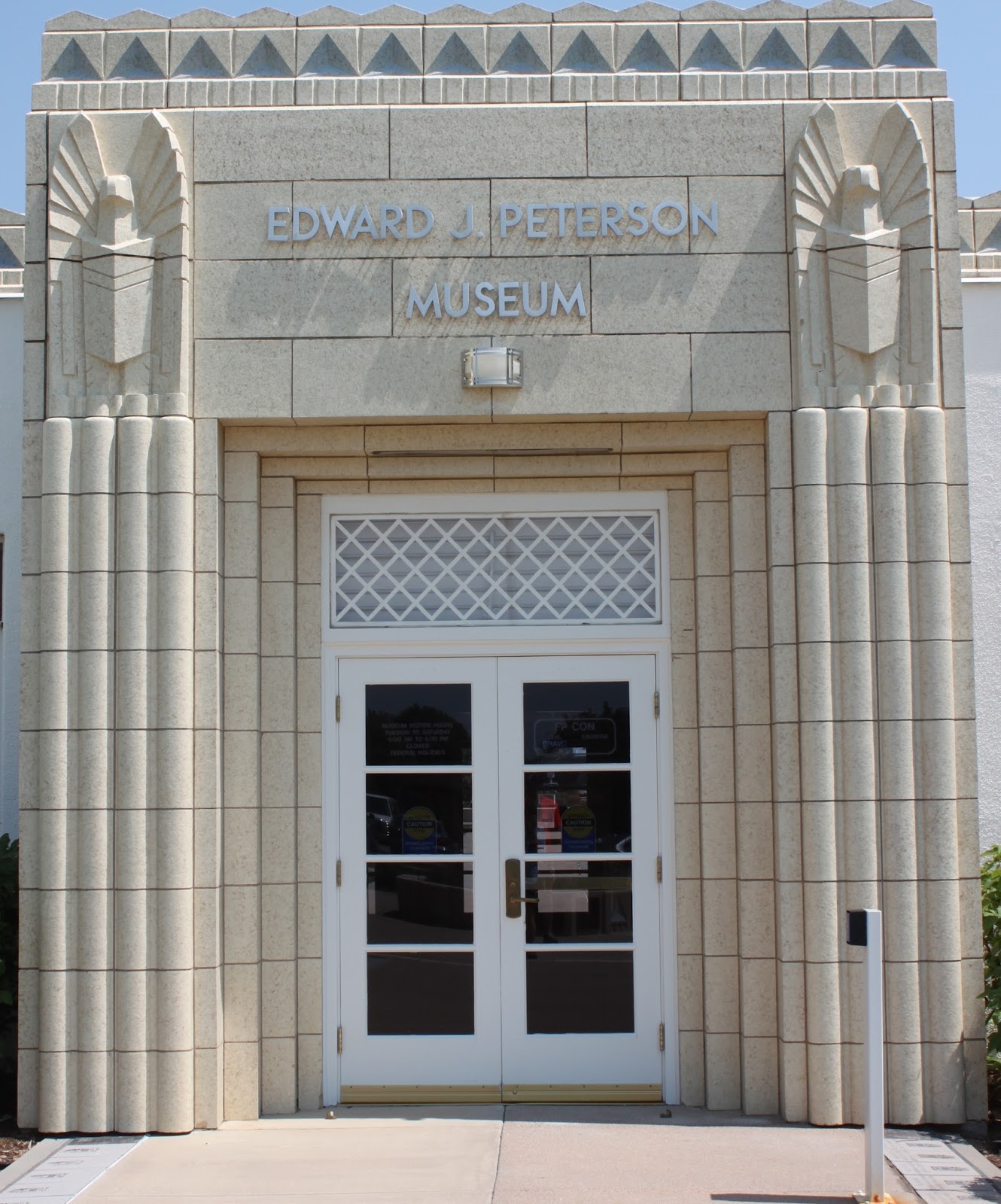
Notice the elaborate architecture around the main entrance. The modern eagle or thunderbird design is now the symbol for this museum.
After we watched a short video, our tour guide explained this mural of the WWII era, showing glimpses of life on this base here in Colorado Springs.
What was most interesting was the lower section of the mural. Major General U. G. Ent (seated in the tan uniform) is shown discussing a secret bombing mission with Paul Tibbets (standing). This was the beginning of the plan for Tibbets to fly the Enola Gay over Hiroshima. Dropping this atomic bomb on Japan would eventually bring an end to WWII.
This Nazi flag on display in the museum was once flown at Stalag Luft VII in Moosburg, Germany, where many downed American airmen was kept after being captured.
After American tanks busted down the prison gates, some POW's kept a few war trophies from this moment to bring back to the United States, among them, this Nazi flag. Look closely and you will see barbed wire around the flag from this POW camp.
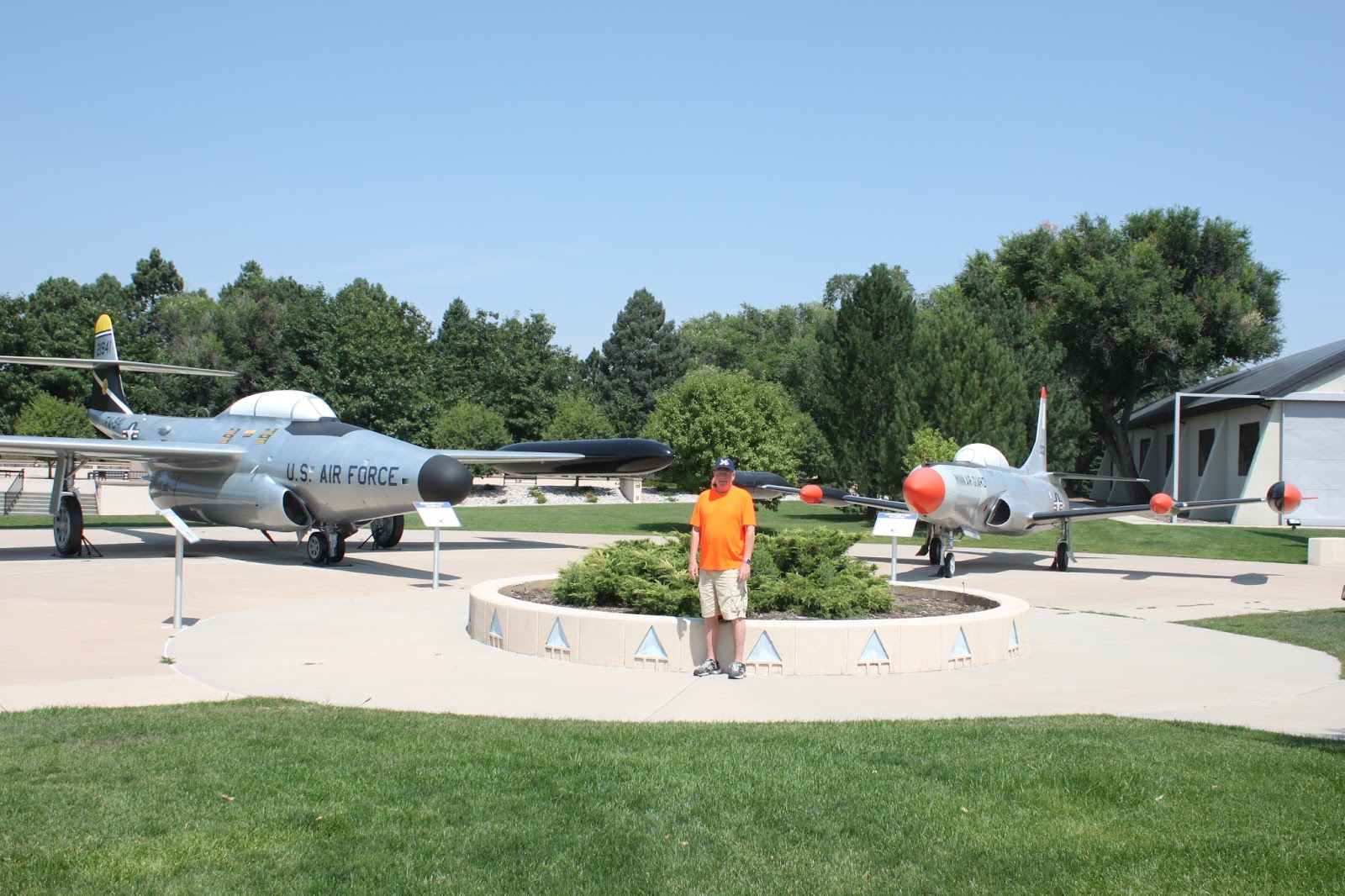
The museum also included many historic aircraft in a large outside display area. Paul is standing between an F-89J Scorpion, an Air Force interceptor from the 1950's, and an F94C Starfire, one of the first low altitude fighters flown in the late 1940's through the 1950's.
Several types of guided missiles were on display as well. This is a Boeing CIM-10A "Bomarc" ground to air interceptor missile designed to destroy enemy aircraft during the Cold War days of the early 1960's.
The HAWK (Homing
All The Way Killer) missile was the first mobile medium-range
surface-to-air system used by the US Army, entering service in August
1959. This HAWK system has in the markings of the 68th Air Defense
Artillery, US Army Air Defense Command, which defended southern Florida from potential air attack in the 1960's.
The museum contained a replica of a ICBM launch control center that was designed for use during the Cold War to launch missiles against targets in Russia.. Here you can see seat #1 which has both launch keys locked in the red box just above the seat. Both operators had a key to a separate padlock to open the container housing the missile launch keys. The double redundancy was a preventive measure to avoid an accidental launching of the missiles. The operator in seat #1 first put his key in the operating slot.
Across the room seat #2 is far enough away so that one person could not turn both keys simultaneously. This is an added security measure to prevent one man from launching an accidental nuclear attack.
If you look to the right of seat #2 you see where the key gets inserted and turned to the right to launch the missile.
We could enter and tour the Warning Star, an airborne early warning and control aircraft used from the 1950's through the 1970's. The massive radomes above and below the fuselage carried six tons of electronic gear.
Paul is going on board.
These EC-121 aircraft flew patrols off U.S. coasts as an aerial extension of the Distant Early Warning (DEW) Line. These planes carried a crew of up to 22, including flight crew and radar operators or technicians.
These radar planes had a range of 4,000 miles and would sometimes stay airborne for more than 12 hours at a time. Multiple radar operators were utilized. Could you imagine sitting in front of this tiny radar screen for longer than a few hours at a time?
Our visit was memorable in that it allowed us to look back at the Cold War era when we were growing up. As children and young adults in the 1950-1970's, we were not as aware of the potential damage just one unintended missile could have done to the world we know today.
We have enjoyed our hikes in North Cheyenne Canyon just west of Colorado Springs so much that we decided to go back one more time on a cool August morning. This is the view from the trailhead (7,500 ft. above sea level) looking towards Colorado Springs (at elevation 6,000).
The side of the hill next to the parking lot gave us hints of what happened here millions of years ago when glaciers melted and the water formed these rocky crevices in the sand that turned to rock.
Early in the hike we saw layers of rock among the sandy slopes along the trail. It is almost as if the early settlers here put small dams in place to slow the flow of water down the hillside.
The hillside along the trail soon became much more steep and rocky.
The first part of the trail was an easy hike on mostly level sandy ground. All of a sudden, the trail became very rocky and steep.
After going a little further down the trail we spotted this small waterfall.The sounds of the rushing water were soothing to our tired feet.
We did see several new beautiful wildflowers along this trail. First, Horsemint,
Spreading Yellowcress,
Meadowrue,
White Fairy Trumpet flowers,
and Alpine Goldenrod. Throughout the summer, we have been amazed that we have seen so many new wildflowers hiking in the Colorado mountains and canyons.
We have thoroughly enjoyed all our hikes in Colorado. We will miss hiking in the Pikes National Forest at the base of the Rocky Mountains when we get back to flat Florida.
Colorado Springs is home to the U.S. Olympic Training Center. We decided to visit the place where U.S. athletes go with dreams of making the U.S. Olympic team for the summer games. There is a winter sports training facility in Lake Placid, New York that caters to the training for the winter Olympics sports.
The training center was tucked in an older residential neighborhood. However, the architecture of the buildings is modern and striking to the eye.
This large globe contains a small plaque for each Olympic sport around the base as well as the five Olympic rings. Does Paul have the weight of the world on his shoulders?
Our tour began with a very informative video about the training facility and some of the athletes that train there. After the video, our tour guide took us through the campus. First stop was the athlete dorms and dining hall. Did you know the head chef here has won cooking contests against some of the most notable chefs in the world?
We visited several of the practice facilities. This sign outside this gym pays tribute to the men's and women's indoor volleyball and beach volleyball.
There were multiple courts in the gym. The main court is used for both basketball and volleyball.
The natatorium was actually larger than an "Olympic size" swimming pool. There were 10 lanes. We did not see any of our Olympic swimmers during our visit, although our tour guide said Michael Phelps was in Colorado Springs a few weeks ago.
Caleb, our guide, was pointing out the fitness facility across the walkway.
This fitness facility contained a large assortment of free weights, machines, an indoor running track above the main floor, and a larger track that goes around the main floor and then goes outside towards the west through large doors that can be opened in the warmer weather.
Our Olympic athletes not only gain the skills of their sport here in Colorado but benefit greatly from training at 6000 feet above sea level. We enjoyed seeing the facilities that are available to our Olympic athletes that they can use to get ready for the summer games.
Three years ago when we made our last trip to Grand Teton National Park, we stopped in the Colorado Springs area. We spent a little time at Garden of the Gods Park but vowed we would come back to explore this natural wonder in more depth.
On a warm day, we started out early to beat the heat and took a short drive down I-25 to Garden of the Gods Park. The photo below was taken at the visitors center with Pikes Peak on the left. You can barely see a few patches of snow on America's Mountain.
In 1971, Garden of the Gods was designated a National Natural Landmark. It is easy to see why this is one of the "must see" places in Colorado Springs.
We took a short drive to the parking lot where we would enter the park's most popular hiking trail We strolled along the trail, viewing all the different rock formations, paying attention to their different colors.
This particular tower of stone is called White Rock. The rock is Niobrara and is much lighter in color than most of the other rock formations in the area.
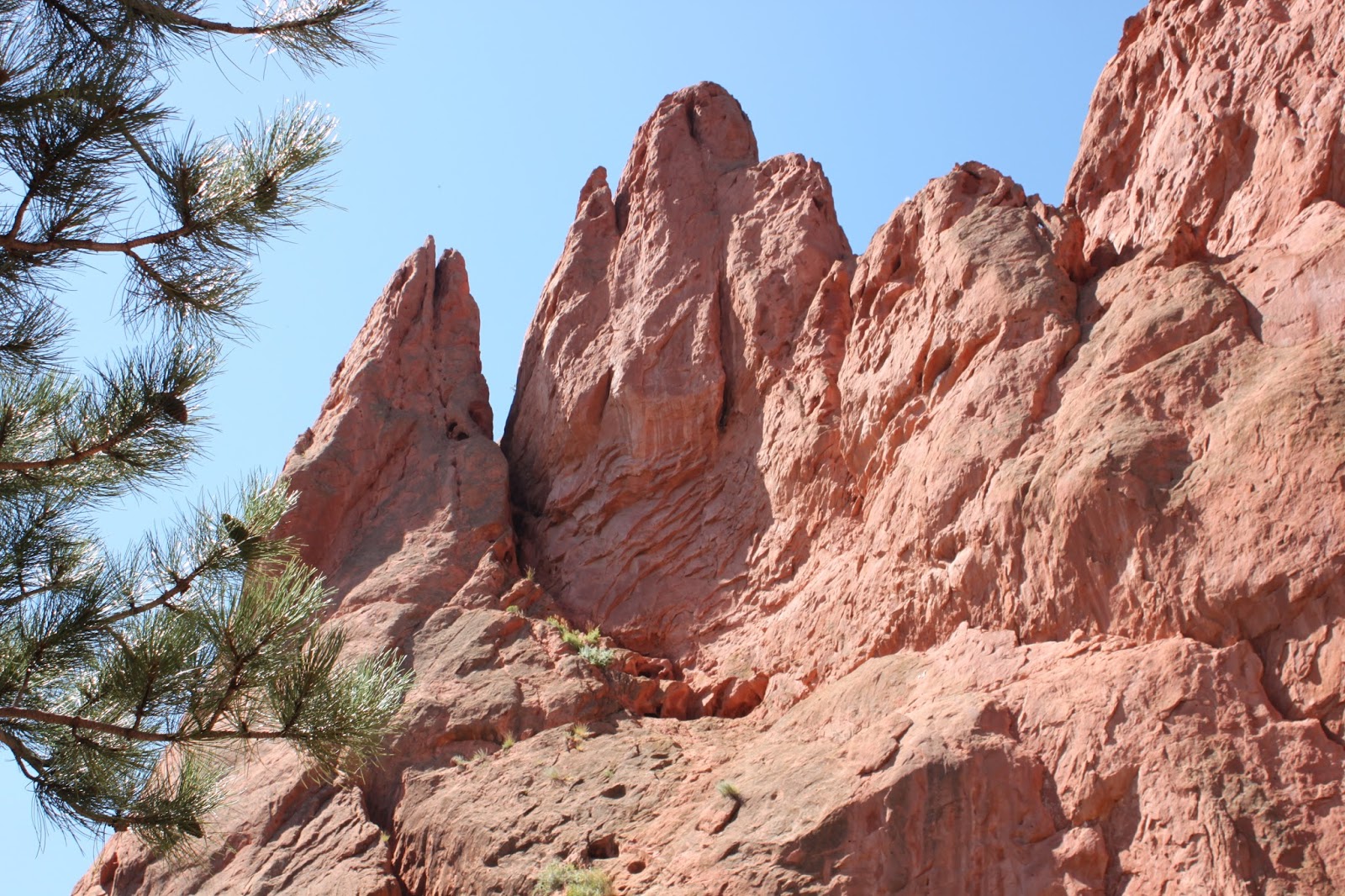
This larger rock formation is called North Gateway Rock. The rock type is Dakota Sandstone and is a dark red in color. The rock looked shiny in the bright sunlight. This is the color of must of the rocks in Garden of the Gods.
 This rock formation is called Signature Rock, possibly because of the towers pointing towards the sky.
Sentinel Rock is a rock formation comprised of both Niobrara rock in the left spire and Dakota Sandstone on the right. Paul at 6'1" is standing at the base which gives you an idea that Sentinel Rock is nearly a 100 feet tall. The
various layers in this rock were deposited 275 million years ago. This
was once a stream bed and is now in a vertical position after the
sediments were turned into solid stone. These rocks have continued to
change shapes as water freezes in cracks and wind erodes the soft
sandstone.
The Kissing Camels (see the top center) tower above a field of Brown Eyed Susan wildflowers. The small patch of sky is between the two camels kissing.
We hiked up a trail and had this view looking back towards the various rock formations. Notice how green all the shrubs and trees are. Colorado has had a wet summer compared to what is considered "normal".
Three Graces is framed by green trees and a cobalt blue sky with a few white puffy clouds in the distance.
The Tower of Babel.
Sleeping Giant.
The plaque commemorates the donation of this land to the City of Colorado Springs by the children of Charles Perkins.
The beauty, grandeur and challenge of Pikes Peak has lured people to its summit for hundreds of years. Below, Pikes Peak is seen in the distance, framed by green trees along the trail .
Balance Rock, the most famous formation in the park. Notice how many tourists are here on this summer day.
Climbers are permitted in Garden of the Gods as long as they obtain a permit and have the proper climbing gear. We found this climber coming down the slope. There are companies in this area that would be happy to give us this experience - for money - but we are a little too old for this type of activity.
The only new wildflowers we saw today were these brightly colored Elephant flowers.
We had a good time playing tourist while visiting the Garden of the Gods. We definitely took our time to explore this natural beauty. The rock formations were more awe inspiring in person than our camera could capture.